
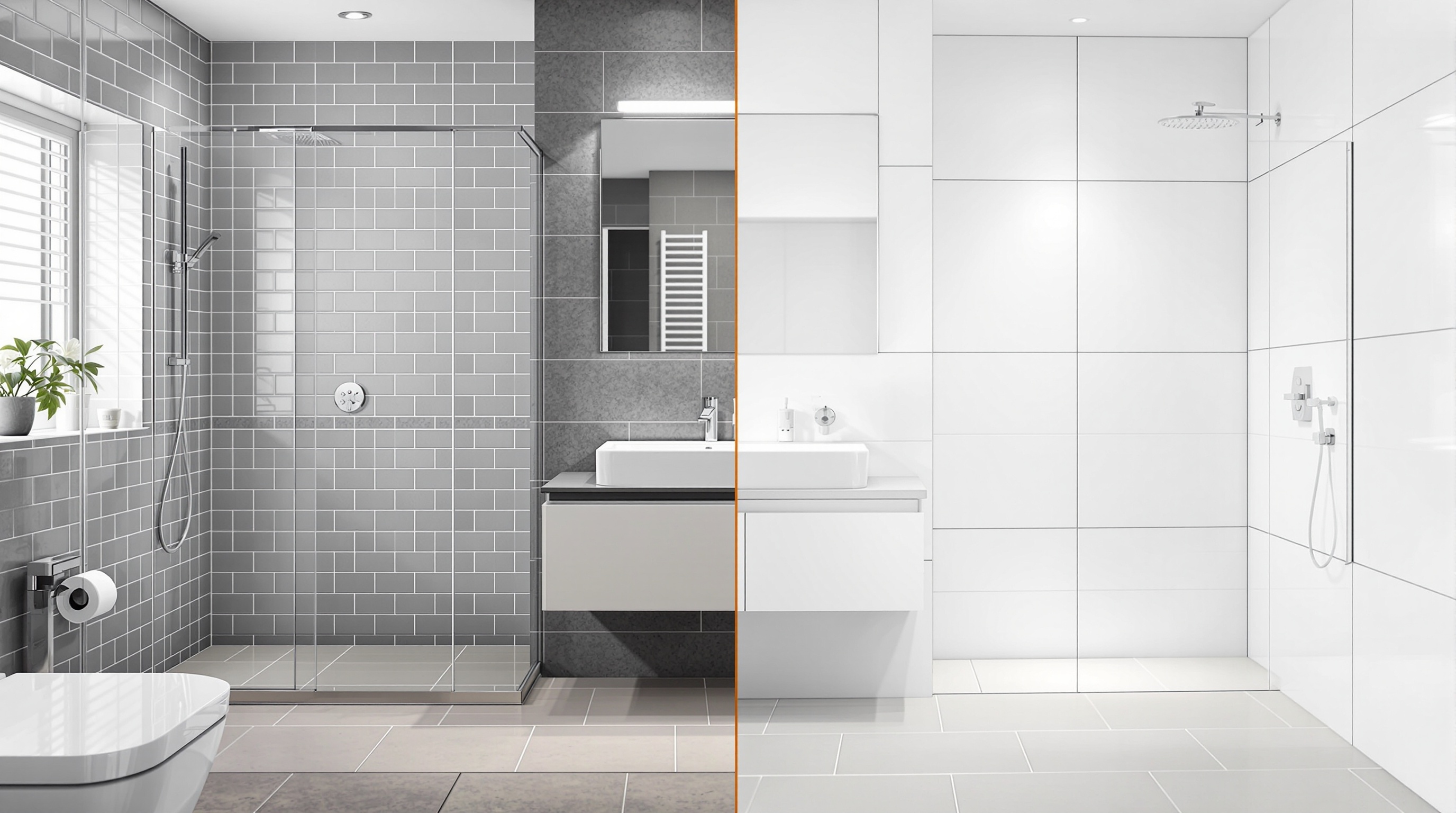
If you're renovating a bathroom, you've probably asked yourself: should I tile it, or go with wall panels? It's one of the most common questions we get at Splash Supply Co — and the honest answer is that it depends on your priorities. This guide breaks down the key differences between bathroom wall panels and ceramic tiles across cost, installation time, maintenance, and longevity, so you can make the right choice for your project.
Cost Comparison
Wall panels are almost always cheaper overall
When comparing the cost of wall panels vs tiles, most people focus on the material cost alone — but that's only part of the picture. Ceramic tiles are often cheaper per square metre than PVC wall panels, but the total cost of a tiled bathroom is significantly higher once you factor in adhesive, grout, tile spacers, and the labour cost of a professional tiler.
A standard bathroom can take a professional tiler two to three days to complete. At typical UK day rates, that's a significant labour cost on top of the materials. PVC wall panels, by contrast, can be installed by a competent DIYer in a single day — and even if you're using a professional fitter, the installation time is dramatically shorter.
For landlords and property developers fitting out multiple bathrooms, the cost saving from switching to wall panels can be substantial. Faster installation means lower labour costs, and the durability of PVC means fewer call-backs and repairs over time.
- Tiles: lower material cost, but higher labour cost and longer installation time
- Wall panels: slightly higher material cost, but much lower total cost when labour is included
- For DIY installation, wall panels are significantly cheaper overall
- For multiple bathrooms, the saving from wall panels compounds quickly
Installation Time
Wall panels install in hours, not days
This is where wall panels have a clear and significant advantage over tiles. A standard bathroom can be fully panelled in a single day — sometimes less. The large format panels (2400 x 1000mm) cover a lot of wall area quickly, and the tongue-and-groove system locks panels together without the need for adhesive between each panel.
Tiling a bathroom, by contrast, typically takes two to three days. The tiles need to be laid in sections, the adhesive needs to cure before grouting, and the grout needs to dry before the bathroom can be used. For landlords turning properties around between tenancies, or homeowners who need their bathroom back quickly, this time difference is significant.
Wall panels also require less preparation. Tiles need a perfectly flat, stable substrate — any movement or unevenness will cause tiles to crack or adhesive to fail. Wall panels are more forgiving of minor imperfections in the substrate, which can save time on preparation.
Maintenance
No grout means no grout problems
Grout is the Achilles heel of a tiled bathroom. Over time, grout discolours, develops mould, and eventually needs to be re-sealed or replaced. In a busy bathroom — particularly in a rental property — grout can start to look tired within a year or two of installation.
PVC wall panels have no grout. The seamless surface is easy to wipe clean with a damp cloth, and there are no joints for mould or bacteria to accumulate in. This makes wall panels a significantly more hygienic option for bathrooms, and dramatically reduces the ongoing maintenance required.
For landlords, this is a particularly important consideration. A tiled bathroom that looks great on day one can look tired and grubby within a few years, requiring expensive re-grouting or re-tiling. A panelled bathroom, by contrast, will look as good in five years as it did on the day it was installed — with nothing more than a regular wipe-down.
- Tiles: grout discolours, develops mould, needs regular cleaning and eventual replacement
- Wall panels: seamless surface, no grout, wipes clean in seconds
- Wall panels are more hygienic — no joints for bacteria to accumulate
- For rental properties, wall panels dramatically reduce maintenance costs
Longevity and Durability
Both can last decades — but panels are more forgiving
A well-installed tiled bathroom can last 20 years or more. But tiles are brittle — a heavy impact can crack a tile, and replacing a single tile in an existing installation is notoriously difficult (matching the colour and pattern of an old tile is often impossible). Grout also degrades over time, and a bathroom that hasn't been re-grouted in ten years will often look significantly worse than one that has.
PVC wall panels are impact-resistant and won't crack under normal use. They're also 100% waterproof — unlike tiles, which rely on grout to keep water out, and where a single cracked tile or failed grout joint can allow water to penetrate behind the wall. In a wet room or shower enclosure, this can cause serious structural damage over time.
The key advantage of wall panels in terms of longevity is consistency. A panelled bathroom looks the same in year ten as it did in year one — there's no grout to discolour, no tiles to crack, and no sealant to fail. For landlords and property managers, this predictability is invaluable.
Aesthetics
Tiles offer more variety; panels offer a cleaner look
This is the one area where tiles have a genuine advantage. The range of tile designs, sizes, and finishes available is enormous — from classic white subway tiles to large-format marble-effect porcelain, the options are almost limitless. Tiles also allow for more creative layouts, including herringbone, chevron, and brick patterns.
Wall panels have come a long way in recent years, and the range of finishes available from Splash Supply Co is extensive — gloss marble, super-matt, sparkle, cut-tile effect, UV marble sheets, and more. But the honest truth is that tiles still offer more variety in terms of design options.
Where wall panels win on aesthetics is in the seamless, joint-free finish. A panelled bathroom has a clean, contemporary look that many homeowners and designers prefer to the grid of grout lines that comes with tiling. In a modern bathroom, the seamless look of wall panels can actually be more visually impressive than tiles.
The Verdict
Wall panels win on cost, speed, and maintenance
For most bathroom renovation projects — particularly for landlords, property developers, and homeowners who want a low-maintenance bathroom — wall panels are the better choice. They're faster to install, cheaper overall, easier to maintain, and more durable in the long run.
Tiles remain the better choice if you want maximum design flexibility, or if you're creating a high-end bathroom where the aesthetic is the primary consideration and budget is less of a concern.
At Splash Supply Co, we supply trade-quality bathroom wall panels to customers across the UK. Browse our full range of PVC wall panels, or submit a trade order request and our team will call you to discuss your project.
See It in the Real World
Shop Bathroom Wall Panels
No payment taken online — we call to confirm your order.
FAQs
Frequently Asked Questions
Shop the Products Mentioned in This Guide
Click any product to view full details, images, and pricing.
Ready to order? We'll call you first.
No payment taken online. Build your order, submit a request, and one of our team will call to confirm stock, quantities, and delivery cost.